Archive for the ‘Tokyo food blog’ tag
[TOKYO] Royce Fruit Bar Chocolate
LIKE MY FACEBOOK PAGE OR FOLLOW ME ON 微博!
I am in love with Royce’s 生チョコレート(Nama Chocolate), but this time I tried a box of their Fruit Bar Chocolate just to see what it’s like.

The packaging is beautiful and thoughtful, very Japanese.


So what is it? White chocolate flavored with strawberry powder, then made crispy and chewy with almond puffs, dried mango and cranberry bits, then infused with a hint of banana.


For me, Royce Fruit Bar Chocolate looked better than it tasted – but that might be because I’m not a fan of white chocolate. For those interested, the price is 10 bars for ¥693 or 18 bars for ¥1,155. Click here to see their full product selection.
[TOKYO] Juchheim Baumkuchen
Join my Facebook page!
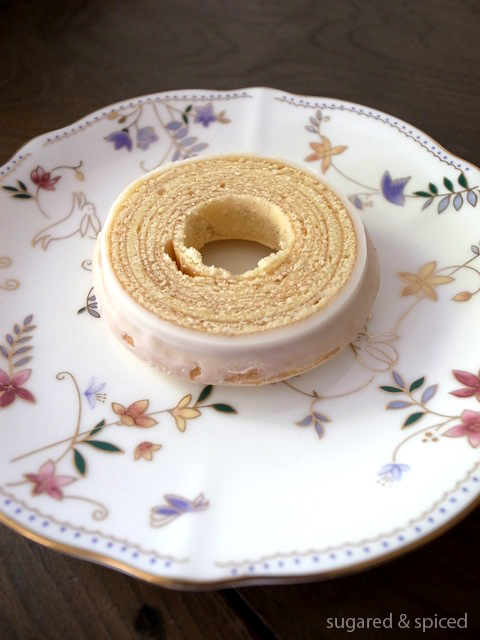
Juchheim Baumkuchen
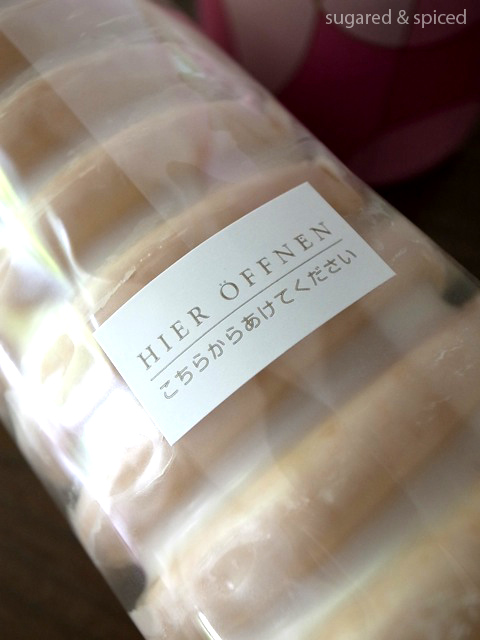
Thanks to having a relative who frequently travels between Tokyo and Shanghai, my family often receive beautifully crafted Japanese confectioneries (see my previous posts on Hiyoko and Fukusaya). A frequent present that she showers upon us is Juccheim Baumkuchen, a traditional German cake that was first introduced to Japan in 1909 by a German confectioner Karl Juchheim, and has since then be refined and adapted to the Japanese palate.


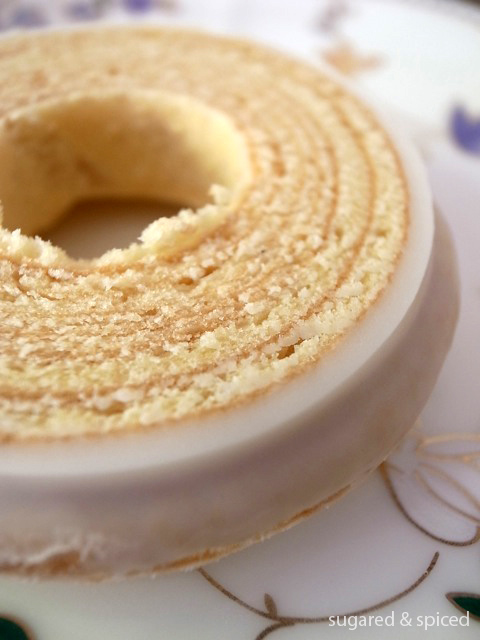
Baumkuchen literally means “tree cakes”, presumably because its layers resemble the growth rings of trees. Each layer of the baumkuchen is made with soft batter produced by whisking the egg yolk and egg white separately, and the emulsifying of the egg yolk and the foaminess of the egg white produce a soft and fluffy texture.


[TOKYO] Hiyoko ひよこ饅頭
Join my Facebook page!
Hiyoko ひよこ饅頭
This popular Japanese chick-shaped snack, originally invented in Kyushu, has been around since 1912. What it is – a thin, soft pastry shell wrapping sweet lima bean paste with a consistency similar to egg yolks. This treat is simple and delicious, perfect with a cup of hot tea!


Unwrapping the packaging reveals the chick-shaped cake. Cute? Cute!


A thin, soft pastry wrapping sweet lima bean paste. When accompanied by a cup of hot tea, this makes the perfect afternoon snack.


For more information on store locations etc., please refer to the official Hiyoko website.
[TOKYO] Toraya 虎屋
Join my Facebook page!
Toraya 虎屋
Address*: Galleria B1F, Tokyo Midtown, D-B117, 9-7-4 Akasaka, Minato-ku, Tokyo, Japan
Tel: +81-3-5413-3541
Hours: 11:00am-9:00pm
Website: www.toraya-group.co.jp
*Various locations in Japan and France. Check website for details.
Tokyo Midtown Galleria B1F is a foodie wonderland. Sleek and stylish shops of Sadaharu Aoki, Henri Le Roux, Jean-Paul Hévin, and Maison Kayser bewitch passerby with their alluring display of bright colors and fancy garnishes. Admist all the hustle and bustle, the understated elegance of Toraya is in a class of its own. One of the oldest makers of traditional Japanese sweets, Toraya has been supplying confectionery to the Imperial Family since the 16th century. For those with an appreciation for the subtle sensibilities of wagashi (和菓子), Toraya is a must-visit.
Simple, beautiful packaging
The sweets at Toraya appeal to much more than just the sense of taste. Rather, they engage all fives senses of appearance, taste, texture, scent, and sound. Appearance: the beautiful combination of shapes, colors, and designs, inspired by both natural and cultural images, is a feast for the eyes.Texture: soft or crisp, moist or dry, the texture one feels when handling, cutting, and tasting the sweets reveal the quality of ingredients and superior craftsmanship. Taste: the natural, distinctive flavors of ingredients are showcased through careful preparation. Scent: delicate fragrances enhance the taste without overwhelming the subtleties. Sound: lyrical names from classical prose or poetry, often suggestive of a particular season, are a pleasure to the ears.
Two types of monaka
Despite being overdosed on sweets from Toshi Yoroizuka, I bought a box of monaka (最中), confectionary made of azuki bean filling sandwiched between two thin crisp wafers made from sticky-rice. The package includes two varieties of monaka: cherry blossom shape with soy bean paste (白餡), and plum blossom shape with red kidney bean paste (こし餡). Like most wagashi, monaka are quite sweet and are best when enjoyed with a cup of green tea.
Cherry blossom and plum blossom
Soy bean paste filling
Other than monaka, Toraya also makes beautiful renditions of namagashi 生菓子 (seasonal cakes in the forms of flowers and leaves), yokan 羊羹 (thick jellied sweet made of azuki bean paste, kanten and sugar), higashi 干菓子 (a dry sweets made with glutinous rice flour, sugar and starch), and much more. Next time in Japan, make sure to visit a Toraya branch and try some of their exquisitely crafted Japanese traditional sweets.
Toraya
[TOKYO] Ichiyuu 一遊
LIKE MY FACEBOOK PAGE OR FOLLOW ME ON 微博!
Ichiyuu 一遊
Address: 神奈川県足柄下郡箱根町仙石原837
Tel: 0120-016-213
Price: approx. ¥8,000 ($96)
Website: http://viala.harvestclub.com/restaurant/index.html
During my Tokyo travel, I made a side trip to Hakone, a famous onsen (hot spring) town about 1 hour away from the city. With the help of a friend, we were able to stay at a membership-based onsen resort called Tokyu Harvest Club Viala 箱根翡翠, which not only offers a most relaxing venue for onsen, but also amazing cuisine. While the dishes were not mind-blowingly innovative, they were comforting with clean yet sophisticated flavors.
Ichiyuu
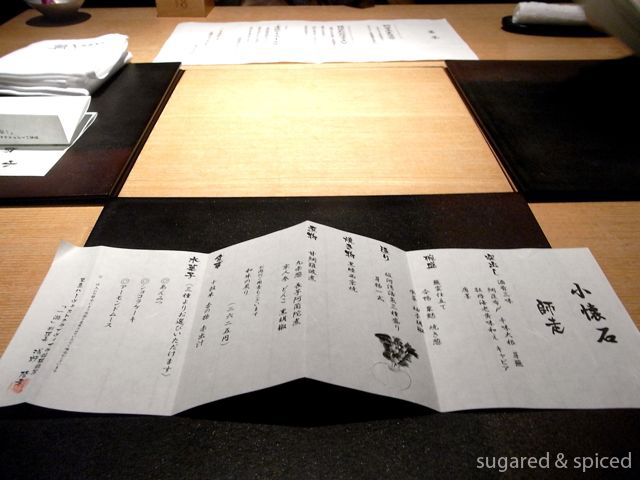
Not wanting to over-stuff ourselves after a nice onsen bath, we chose the small 7-course kaiseiki set. Here’s the menu:
Menu
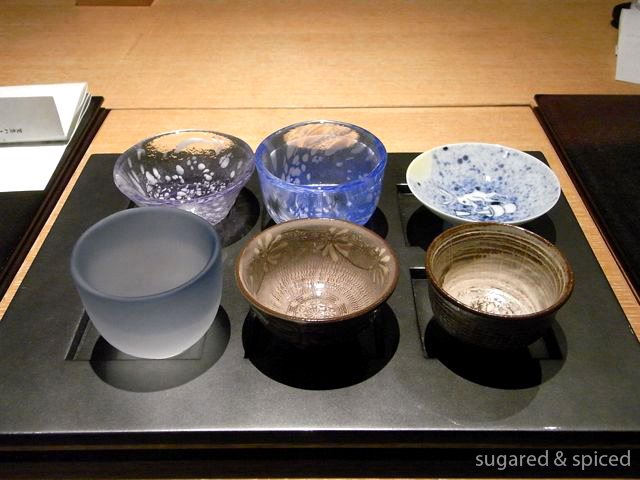
Choose your own sake cup
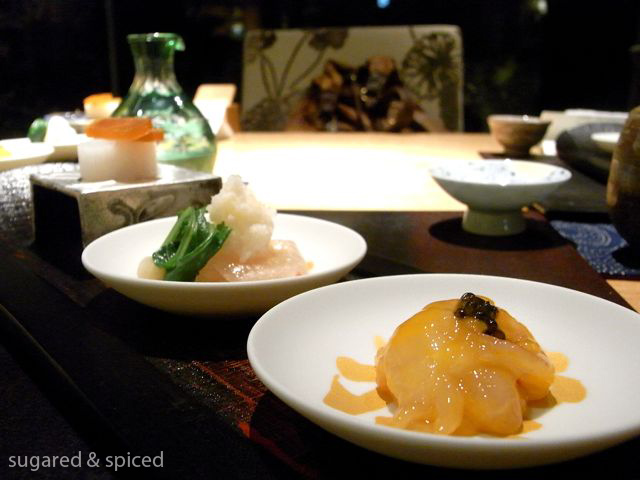
The appetizer was a trio of tidbits. My favorite with the Botan shrimp with caviar, a decadent combination of plump and scrumptiously sweet shrimp with caviar. The intensely flavorful dried mullet roe was also quite memorable, and the circular disk made from paper-thin daikon slices was especially impressive.
Appetizers
Left: Botan shrimp with caviar
Center: Karasumi (dried mullet roe)
Right: Sea bream with daikon and vegetable
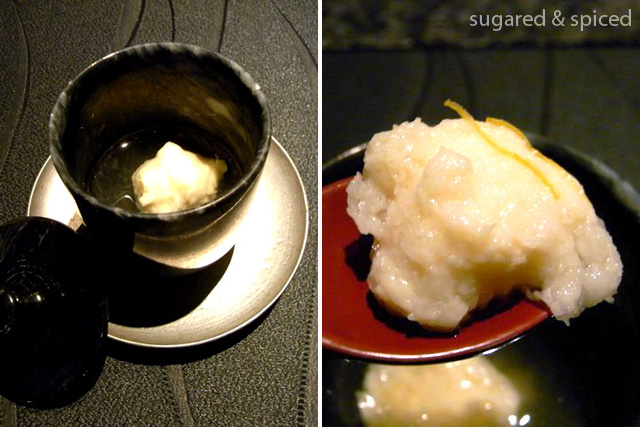
Next on the table was a heart-warming bowl of duck soup with chestnut gluten cake, mizuna, and yuzu pepper. The yuzu pepper ignited a spark in the soup, which was thickcned to an almost gooey consistency. The chestnut gluten cake (栗麩) had an interesting texture that was like nothing I’ve tasted before. The closest I can think of is probably fish tofu, but it was softer, less chewy, and had a mildly sour taste.
Soup with duck, chestnut gluten cake, mizuna, and yuzu pepper
Soup close up
The sashimi dish was beautifully plated. A stalk of purple flower leaned softly on two pieces of transluscently white squid, a curl of lemon peel perched on top of a pale sliver of mackerel while a flower-shaped carrot rested on its side, and two slices of beautiful pink-colored toro (tuna belly) were left to shine on their own. All these were placed on a sunny bright yellow elongated plate that would brighten up even the sourest moods.
Sashimi
[TOKYO] Random Snippets
LIKE MY FACEBOOK PAGE OR FOLLOW ME ON 微博!
Pictures that can’t be categorized with any of the other posts on Tokyo.
Tokyo Tower
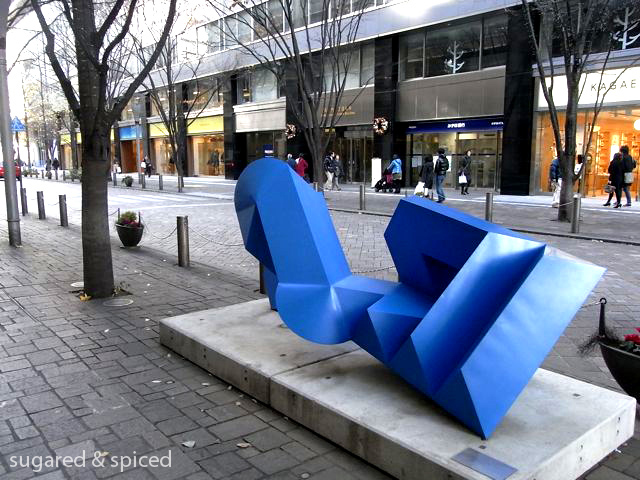
Near Tokyo Station
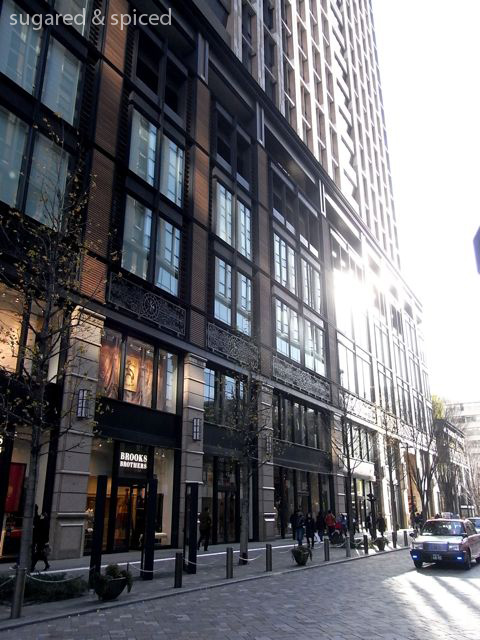
Near Tokyo Station
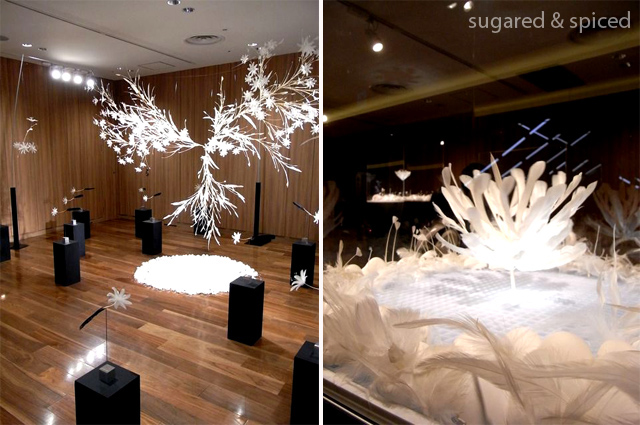
Exhibition on the top floor of Ginza Mitsukoshi
Random shot in Shirokanedai
Cupid at Ginza
Dior & Armani at Ginza
Mikimoto window display
[TOKYO] Fukusaya 福砂屋
JOIN MY FACEBOOK PAGE OR FOLLOW ME ON 微博!
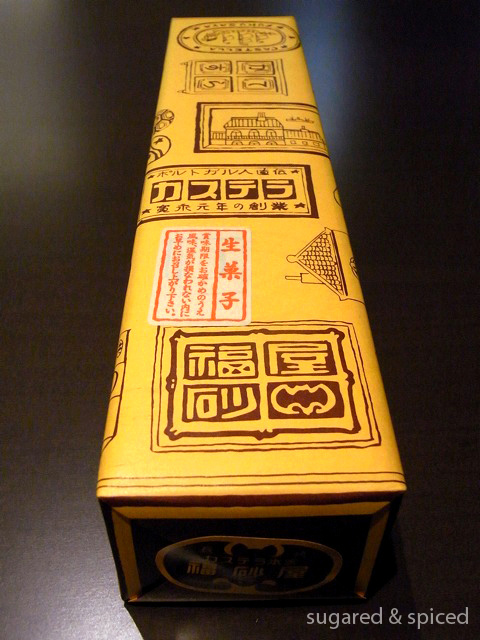
Fukusaya 福砂屋 is a historical cake shop famous for its Castella (カステラ Kasutera), a simple Japanese sponge cake made with sugar, flour, eggs, and syrup. Though it is now a specialty of Nagasaki, Castella originally came from Castile of Portugal, and was brought to Japan in the 16th century. Fukusaya has been baking divinely fluffy and moist Castella since 1624, and their website quite clearly explains how the cakes are baked. As impressive as the taste, on the other hand, is the packaging. Let’s go layer by layer…
Fukusaya Castella
First, a yellow wrapping paper that depicts the founding date of Fukusaya, the shop’s various locations, and its signature bat-shaped logo. In Chinese (which the Japanese also use in the form of Kanji), “bat (蝠)” has the same pronunciation as “happiness/luck (福)” , which is why Fukusaya chose the bat as its store logo.
Outer packaging
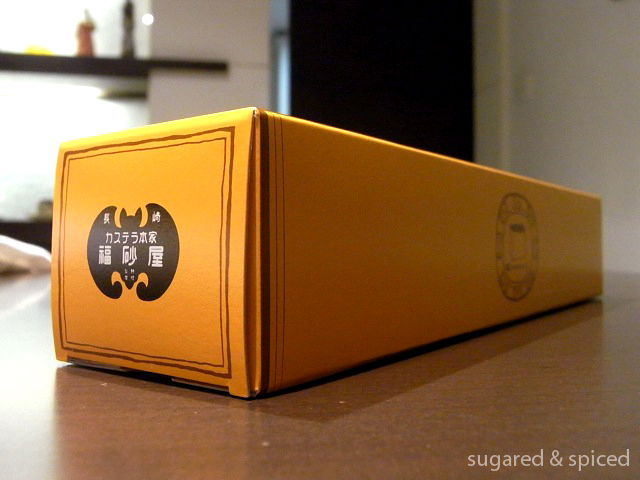
Inside the yellow wrapping paper is a thin but sturdy yellow paper box, again with the bat logo.
2nd layer
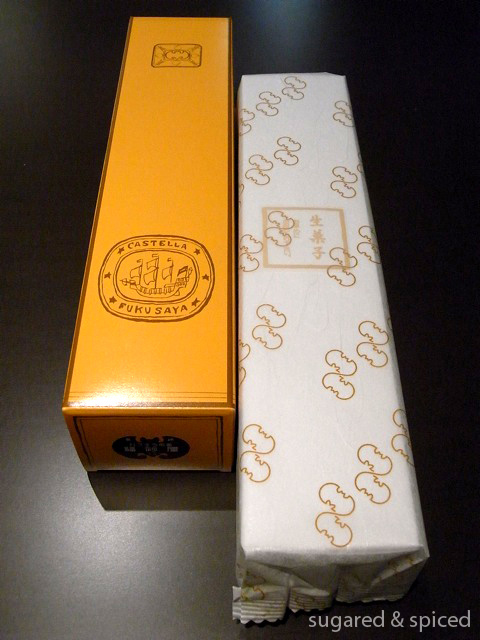
Opening the paper box reveals a sealed washi paper-textured spun polyester sleeve with more bat logos.
2nd layer & 3rd layer
[TOKYO] Roppongi 六本木
LIKE MY FACEBOOK PAGE OR FOLLOW ME ON 微博!
Modern, sleek, stylish.
Here’s how I spent the day in one of my favorite neighborhoods of Tokyo:
Morning: got here before any of the stores opened, wandered around discovering street art here and there.
Delightfully sunny weather
Keyakizaka けやき坂
Street art
More street art
Baller apartment where celebrities and moneyed people live
Le Chocolate de H, saving this for next time
Lunch: skipped the main meal, tried some made-to-order desserts at Toshi Yoroizuka instead.
Biscuit Coulant Chocolat Yuzu
Souffle KAKI
Afternoon: saw a very inspiring exhibition by Issey Miyake at 21_21 Design Sight
An amazing space designed by Ando Tadao, unfortunately wasn’t allowed to take pictures inside
[TOKYO] HARBS
LIKE MY FACEBOOK PAGE OR FOLLOW ME ON 微博!
HARBS
Address: 3F, Marunouchi Bldg 2-4-1, Marunouchi, Chiyoda-ku, Tokyo
Tel: 03-6269-9595
Hours: [Mon-Sat] 11:00am-9:00pm [Sun] 11:00am-8:00pm
Price: [Cakes] ¥600~1200/slice
Website: http://www.harbs.co.jp/harbs/eng_top.html
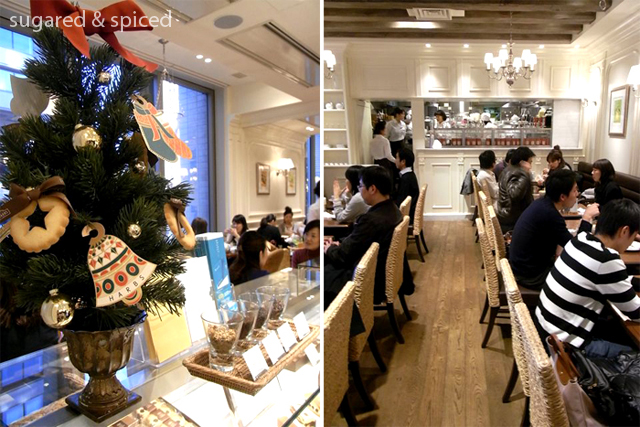
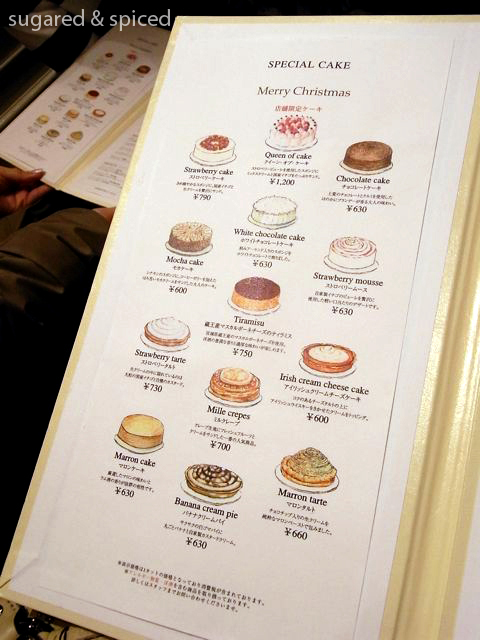
It’s hard to not like HARBS. The warm lighting, the wooden furnishings, the cute hand-illustrated menu, the beautiful, massive cakes on display – all the elements wave invitingly at passerby, luring them to line up one after another at the perpetually long queue. What you’ll get when you are eventually seated are huge cakes that are made fresh daily and sliced by the order, which prevents the sides from getting stale. We went to HARBS in Marunouchi Building, one of the 26 branches in the country, and despite the long line we were seated in about 20 minutes. Bring on the cakes!
A long line at HARBS, as usual
Warm and cozy interior, with Christmas decorations
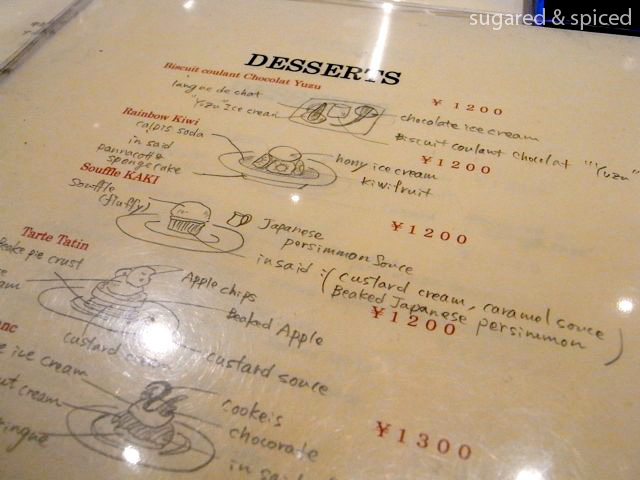
Illustrated menu, lovely!
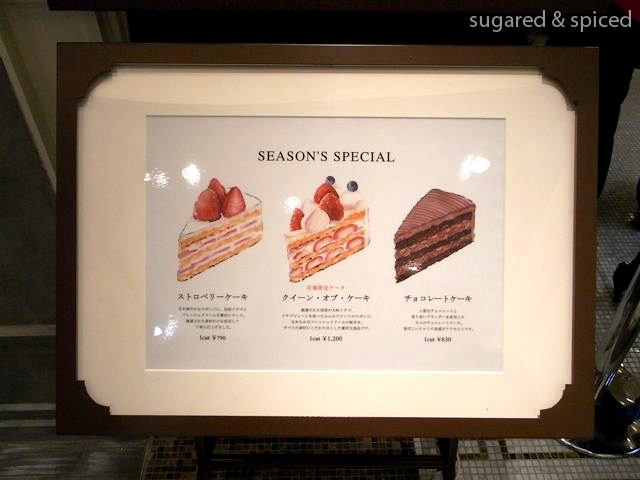
Seasonal Menu
It took us no time to order, since we already decided on our picks during the wait.
[TOKYO] Omotesando 表參道
LIKE MY FACEBOOK PAGE OR FOLLOW ME ON 微博!
Omotesando is so filled with shops and fun things to look at, you can easily spend an afternoon here. This area is known as one of the foremost architectural showcase streets in the world, where fashion flagship stores (LV, Prada, Dior, Tod’s, etc.) compete with each other for the most eye-catching design. Omotesando also has a few side streets that feature a range of more affordable trendy cafes and boutique shops. I came here right after a visit to Meiji Shrine, and couldn’t leave until late into the evening. Here are some snippets of my afternoon:
Omotesando Hills, designed by Ando Tadao, built at a cost of $330 million
Random corner
MOMA Design Store, the first one outside of NY
Bvlgari Il Cafe
Cerfeuil, a jam store that I totally fell in love with
Pudding jam, lovely! Come in different flavors of pudding too.